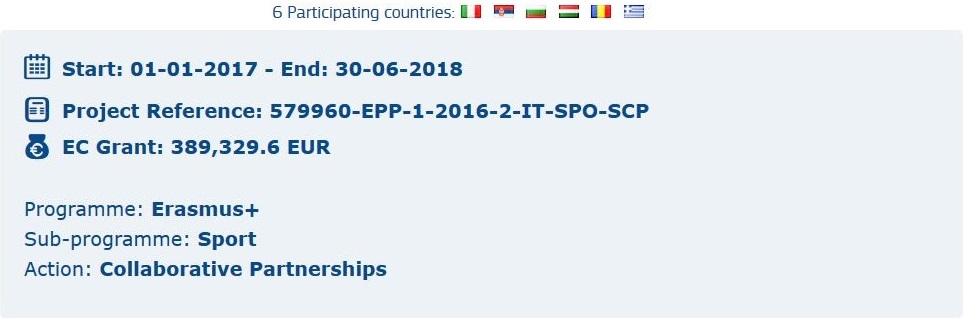
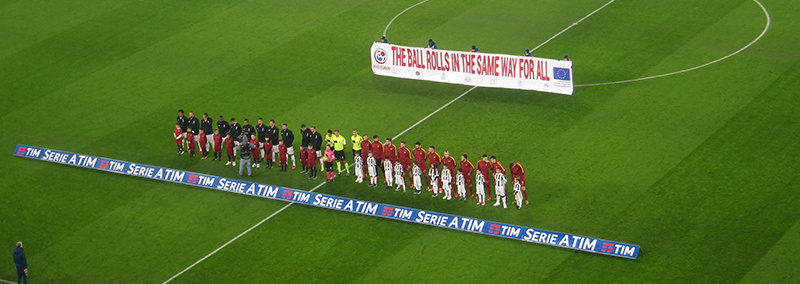
Nowadays, almost during every match we witness situations that see certain players of a team as targets of racist insults or worse, and the recent happenings in Serbia, in the match between Partizan and RAD is just the last example of a long queue of such events. The BRISWA project is an EU-funded project (funded by the ERASMUS+ PROGRAMME - SPORT COLLABORATIVE PARTNERSHIP - GA 2016 - 3060) dealing with the problem of racism in football (and in Sports in general), trying to spread the message of equality among races, genders, religions etc. among football players, especially youngsters, and hence ultimately trying to “kick” racism out of all kind of courts, fields, stadiums and so on.
In order to achieve this, the project will try to reach the following objectives:
- understand the current situation of racism in Europe and identify the main drivers for such a phenomenon
- assess, through a sound scientific approach (System Dynamics Modeling & Simulation) aiming at identifying the most effective policies and strategies against racism, how racist acts can be mitigated and ultimately possibly eradicated from the sport culture
- implement such strategies and policies by starting from the young people, who still do not have a strong social xenophobic bias and hence are most prone, especially in their early ages, to accept different people among themselves, especially when practicing games or sports
- establish what are the skills (psychological, social, etc.) for a new fundamental figure in football teams (and sports teams at large) that will have the important role of early identification of racist drifts in he/his team and thus will ultimately have to put in place preventive and mitigation measures to stop such phenomenon as soon as possible
- disseminate the spirit of equality and avoidance of racist acts throughout Europe, by trying to build a wide awareness in people of all ages (and especially in young children) through the project various channels (Social media, website, etc.) and also by means of focused sport events, training seminars, project meetings and public workshops/conferences ultimately addressing all kind of discrimination as a threat to the roots of sport itself.
The BRISWA project aims at re-examining racism and discrimination in football, defining it in a more concise way and promote a more thorough and active approach against it. The BRISWA approach will try to address the issues in a more comprehensive way. The proposed approach is based on three pillars
- Re-examining racism and defining it more concisely;
- Developing and testing policies to fight racism in football;
- Comprehensive anti-racism campaign;
The proposed approach is based on six pillars.
- Since racism in football is not independent from racism in society, it is essential to study the literature as well as past and current cases with the purpose of identifying those common indicators that cause racism to be created and expressed. In detail, the project aims to analyse:
- The political context;
- The social context;
- The major purpose of this project is to investigate racism in football. In that spirit, anonymous surveys will be designed, developed and distributed to football fans and officials, with the purpose of analysing trends in their opinions and experiences. The results of the first two pillars of the project will be collected and harmonized in a final report called “The Handbook of racism in football”.
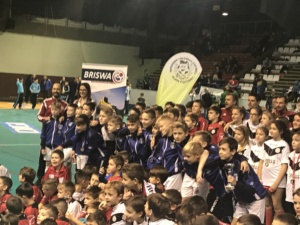
- An important aspect of the European Union is the exchange of information and best practices among specialists and officials of different member-states. The BRISWA project aims at utilising this approach, thus a workshop in each partner’s country will be organized to discuss and disseminate the results of the project during the project lifetime. Hence, the BRISWA project aims at following the encouragement of the European Commission to promote the exchange of
 knowledge, experience and best practices.
 - The data and indicators from the first three steps of the project will be used to create simulation models with the methodology of System Dynamics. The simulation models can be used to identify scenario exemplars on how racism in football is created, what are the circumstances that make it thrive and test policies in a consequence-free environment.
- The fifth pillar of the project will be focused on communicating the results obtained. To achieve the objective, the project envisages the development of an online platform that will allow users to experiment with the simulation models. The BRISWA project results will be communicated and disseminated on different levels: at national level by each partner, emphasizing the learning experiences gained in the project and future actions to be taken to follow up the project; at European and international level through international partners (including associated partners) project. Due to the particular field of interest, addressing a large sector (muc`h later) of sport, the ability to spread plays an even more important role. Therefore, the project results will be disseminated through a variety of channels, according to a distribution plan designed properly.
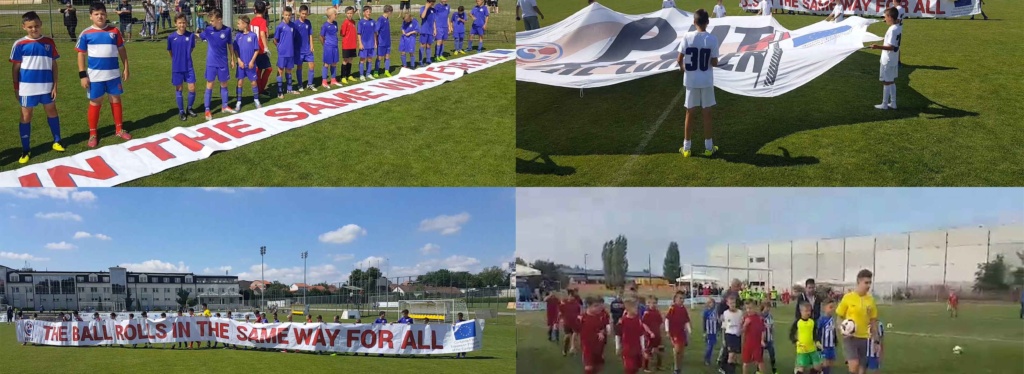
- The final aim of the BRISWA project is to utilize all the results that will be obtained at every step, and develop a targeted anti-racism campaign. The project envisages that the message of the campaign will be demonstrated before the beginning of football games across different national football championship
All activities planned by the consortium will be further enhanced by the involvement of field experts (in the fields of System Dynamics, of the sports world etc.) and an Expert Advisory Board (EAB), that will support all the project phases, from the definition of requirements to the model construction and survey construction and dissemination, as well as through the involvement of end-users (organized in an end-user committee – EUC).





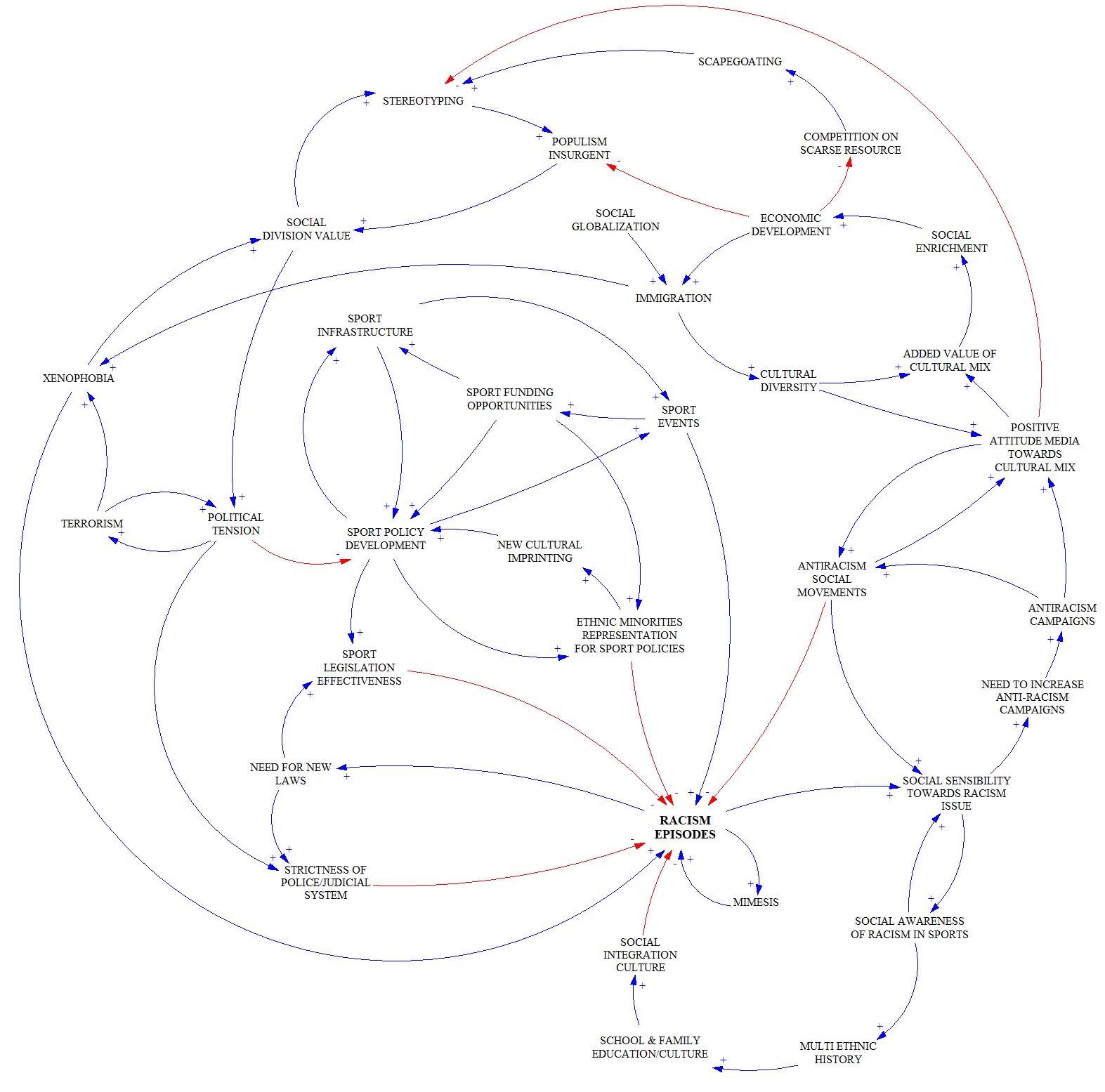
BRISWA Causal Loop Diagram
During the project, leading academics and experts on knowledge areas about discrimination and racism phenomena were contacted. The main characteristic of those experts is that their research has to do with racism and discrimination within sports, football in particular. In order to elaborate a shared model among those experts, a Group Model Building session was organized. In a Group Model Building session, the participants develop one or many models with the help of a facilitator, who must favor the elucidation of knowledge within the group.
By analyzing the final model, showed below, that was developed by the joint action of modelers and experts, some insightful loops were identified. For a better readability, the positive links are in blue and the negative ones in red.
BRISWA Simulation Model
The design of such a tool, which is based on the Causal Loop Diagram explained in the other pages of this section, aims to get better insights into how racism in football emerges and where are the potential areas where policy makers could use as leverage for effective countermeasures. This is possible thanks to the simulative nature of this scientific approach, by means of which the policy-makers may formulate and test different strategies and evaluate their impacts through the analysis of simulated results over time.
The proposed model recreates the trend of racism episodes within football given some specific policies and their magnitude. These policies are represented inside the model as variable-levers and describe different strategies related to:
- Annual investment on Education-Culture;
- Strictness of Police-Judicial System;
- Antiracism events.
Different combination of these three aspects could produce different outcomes and impacts in terms of number of racism phenomena. The advantage of simulating scenarios is that policy-makers could find optimal solutions in terms of desired result and cost-effectiveness, making decisions on a “safe” computer environment.
Simulation model: https://app.sysdea.com/shared/Pon_5tdxF5RGmqbhUhaz-A
This section contains the Manifestations of Interest signed by stakeholders who have expressed their intention to support the Systema project. Signing the MOI grants access to all materials produced within the Briswa project.
Here you can find who have signed our Manifestation of Interest:
[wptb id=3274]
Social
[wptb id=4028]
 Eleonora Piacenza
 Valerio Ciuffini
 Vanessa Armendariz
 Alberto Stanislao Atzori
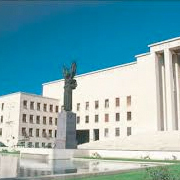 “Sapienza” University
 Andrea Furlan
 Stefano Armenia